
12V & 24V Smart Battery Chargers
Compare 16 charger variants for 6V, 12V and 24V batteries by output current, listed battery capacity, charging program, display type and logistics data. Choose a standard model or request OEM/ODM customization for your market.
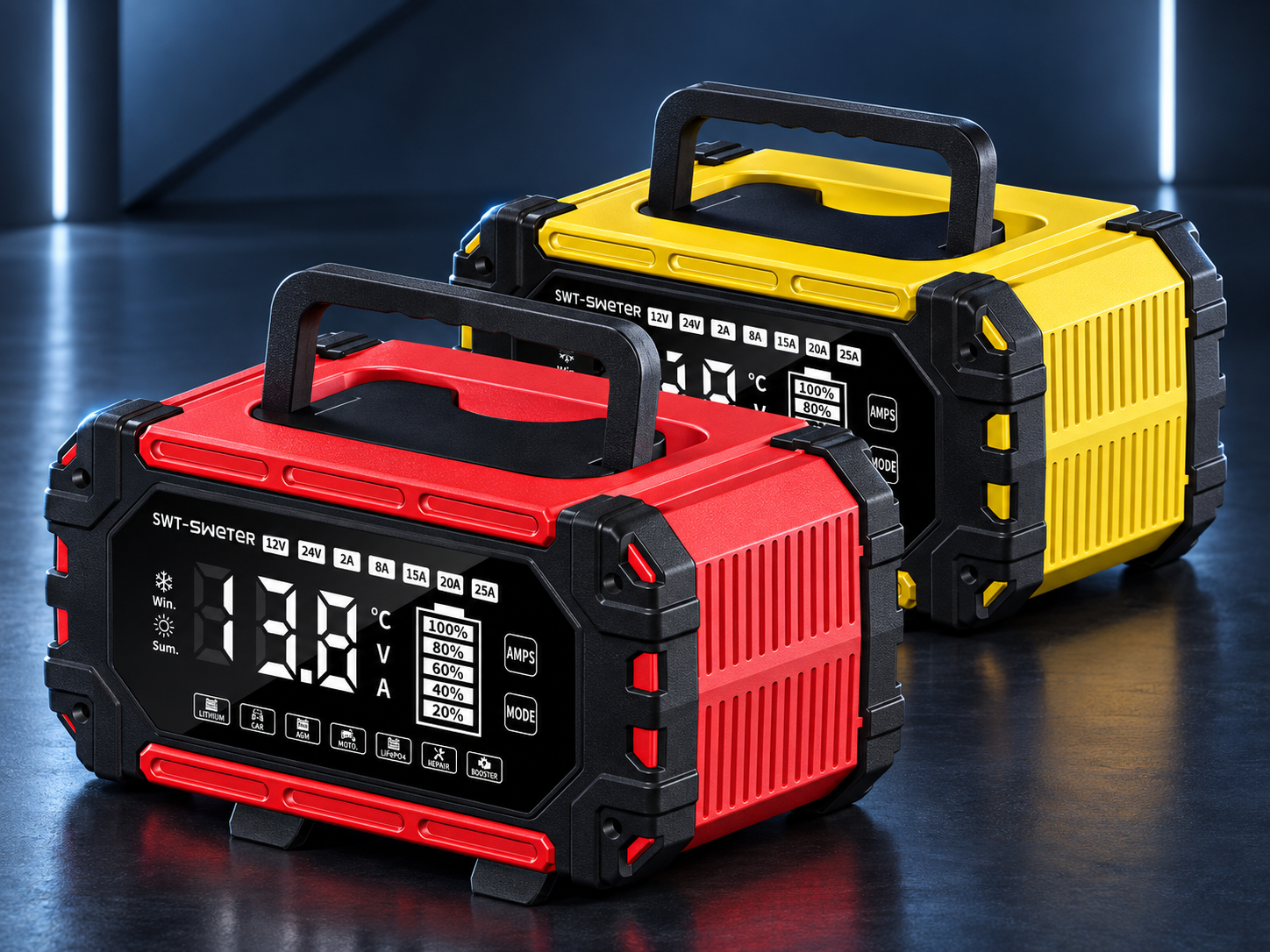
NEW Meet SWT-2025 · 12V 25A / 24V 15A
Listed compatibility includes lead-acid battery types and LiFePO4. Always match the selected charging mode to the battery manufacturer’s requirements.
Choose by Battery Voltage, Capacity and Required Current
Start with the battery manufacturer’s charging requirements. Confirm battery voltage and chemistry, then select a charger whose listed battery-capacity range includes your battery. The battery manufacturer’s maximum recommended charging current remains the final limit.
| Charging Requirement | Listed Battery Range | Recommended Variants | Main Difference |
|---|---|---|---|
| 6V 1.5A / 12V 1.5A | 2–30Ah | SWT-3612 | Compact model and the only 6V-capable variant listed on this page |
| 12V, 6A | 2–100Ah | SWT-3650 | Compact 12V model with automatic battery detection |
| 12V, 6A | 2–150Ah | SWT-3610 / SWT-3668 | Higher listed Ah range with two housing options |
| 12V, 8A | 2–200Ah | SWT-3820 | Standard-display and color-display variants |
| 12V, 10A | 2–200Ah | SWT-1880 / SWT-3830 | Multiple housing and display options |
| 12V, 15A | 4–300Ah | SWT-1215 | Highest-current 12V-only variant |
| 12V / 24V | 4–200Ah | SWT-1205 / SWT-1206 | 10-stage dual-voltage models |
| 12V / 24V | 4–300Ah | SWT-1508 / SWT-1608 | Higher-current dual-voltage models |
| 12V / 24V | 4–400Ah | SWT-2010 / SWT-2025 | SWT-2010: 12V 20A / 24V 10A; SWT-2025: 12V 25A / 24V 15A with carry handle |
Compare All 16 Smart Battery Charger Variants
Use this table to narrow the range before reviewing the full product specifications and packaging information below.
| Model / Variant | Output | Listed Battery Range | Power (Max.) | Charging Program | Main Difference |
|---|---|---|---|---|---|
| SWT-3612 | 6V 1.5A / 12V 1.5A | 2–30Ah | 23W rated | Multi-stage | Compact; automatic 6V/12V detection |
| SWT-3650 | 12V, 6A | 2–100Ah | 96W input | Multi-stage | Compact 12V model with large display |
| SWT-3610 | 12V, 6A | 2–150Ah | 96W input | 3-stage | 150 × 80 × 60 mm housing |
| SWT-3668 | 12V, 6A | 2–150Ah | 96W input | 3-stage | 147 × 80 × 60 mm housing |
| SWT-3820 — Standard Display | 12V, 8A | 2–200Ah | 120W input | 3-stage | Standard display |
| SWT-3820 — Color Display | 12V, 8A | 2–200Ah | 120W input | 3-stage | Color display |
| SWT-1880 | 12V, 10A | 2–200Ah | 150W input | 3-stage | 163 × 88 × 60 mm housing |
| SWT-3830 — Standard Display | 12V, 10A | 2–200Ah | 150W input | 3-stage | Standard display |
| SWT-3830 — Color Display | 12V, 10A | 2–200Ah | 150W input | 3-stage | Color display |
| SWT-1215 | 12V, 15A | 4–300Ah | 230W input | 3-stage | Highest-current 12V-only variant |
| SWT-1205 | 12V 10A / 24V 5A | 4–200Ah | 150W input | 10-stage | Entry dual-voltage variant |
| SWT-1206 | 12V 12A / 24V 6A | 4–200Ah | 180W input | 10-stage | Higher-current dual-voltage variant |
| SWT-1508 | 12V 15A / 24V 8A | 4–300Ah | 240W input | 3-stage | Larger listed Ah range |
| SWT-1608 | 12V 16A / 24V 8A | 4–300Ah | 240W input | 10-stage | 200-second 12V booster mode |
| SWT-2010 | 12V 20A / 24V 10A | 4–400Ah | 300W input | 10-stage | 20A / 10A output; 200-second 12V booster mode |
| SWT-2025 NEW | 12V 25A / 24V 15A | 4–400Ah | 350W input | 10-stage | Highest listed current; carry handle; 200-second 12V booster mode |
Common Smart Battery Charger Applications
These models cover compatible 6V, 12V and 24V batteries used in vehicle, equipment and storage-maintenance applications. Final compatibility depends on battery voltage, chemistry, capacity and permitted charging current.
Motorcycles & Small Batteries
The SWT-3612 provides 6V 1.5A or 12V 1.5A output for batteries within its listed 2–30Ah range.
12V Automotive Batteries
Choose from 6A, 8A, 10A and 15A variants according to battery capacity and the manufacturer’s charging-current limit.
RV, Marine & Auxiliary Batteries
Selected 12V variants list battery-capacity ranges up to 300Ah. Confirm the required chemistry mode before selection.
12V / 24V Workshop Charging
Six dual-voltage variants cover 12V and 24V charging requirements with listed battery ranges from 4–200Ah to 4–400Ah.
12V Engine-Start Assistance
SWT-1608, SWT-2010 and SWT-2025 include a listed 200-second booster mode for assisting a 12V vehicle start.
OEM & Private-Label Programs
Configure branding, packaging, AC plugs, DC connectors and cable requirements for distribution projects.
6V / 12V Smart Battery Charger Models
Ten product variants cover 6V 1.5A / 12V 1.5A through 12V 15A, including standard-display and color-display versions.
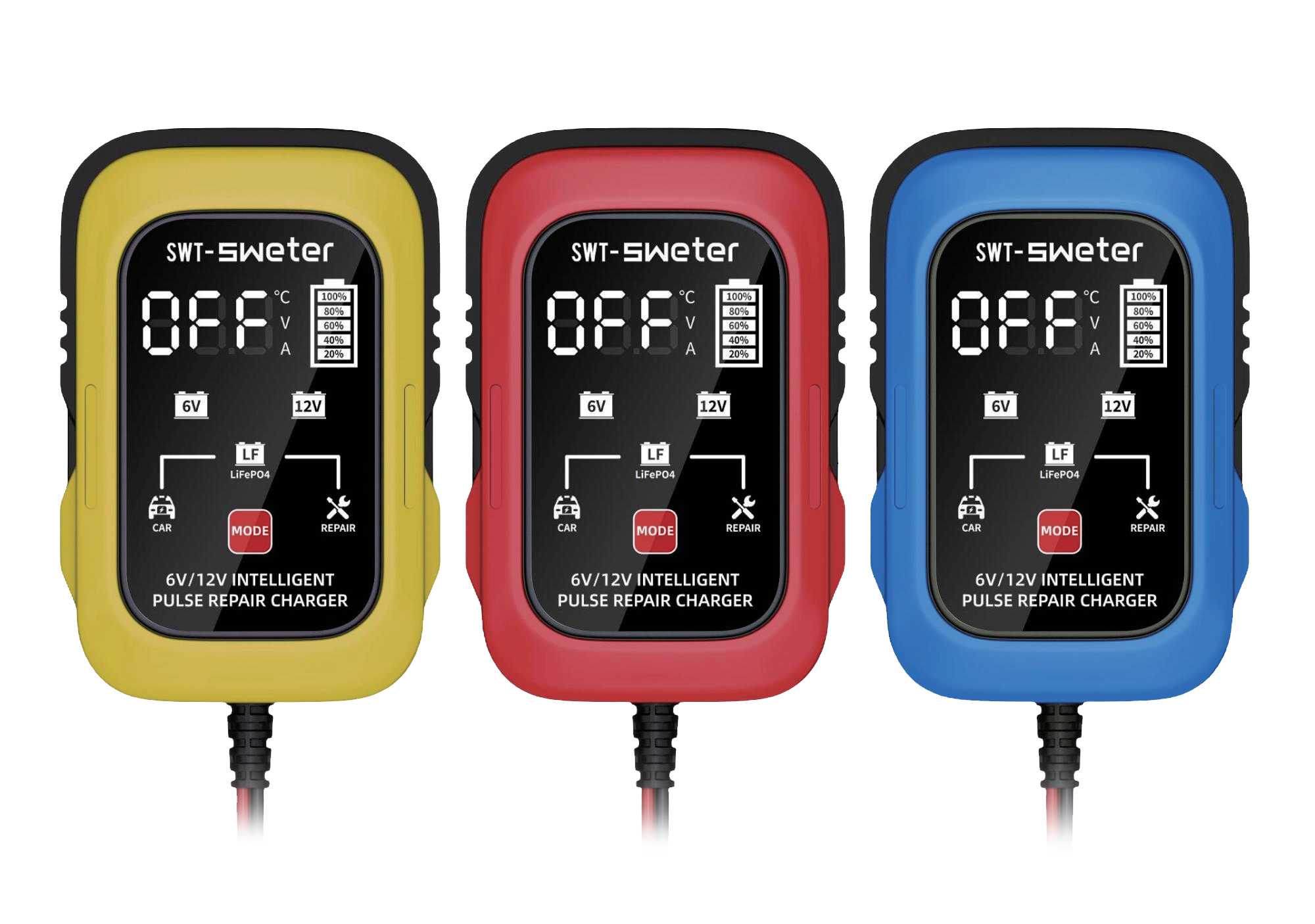
SWT-3612
6V 1.5A / 12V 1.5A
Compact 6V/12V model for batteries within the listed 2–30Ah range. It is the only 6V-capable variant shown on this page.
- Input
- 100–240V 50/60Hz
- Output
- 6V 1.5A / 12V 1.5A
- Rated Power
- Max. 23W
- Listed Battery Capacity
- 2–30Ah
- Thermal Protection
- 65°C ±5°C
- Dimensions
- 108 × 75 × 36 mm
- Net Weight
- 355 g
- Automatic 6V/12V battery-voltage detection
- Pulse repair for compatible lead-acid batteries
- Units per Carton
- 40 pcs
- Carton Size
- 54 × 28.5 × 42.1 cm
- Carton Gross Weight
- 16 kg
- Color Box Size
- 13.4 × 13 × 8.3 cm
- Unit Gross Weight
- 370 g
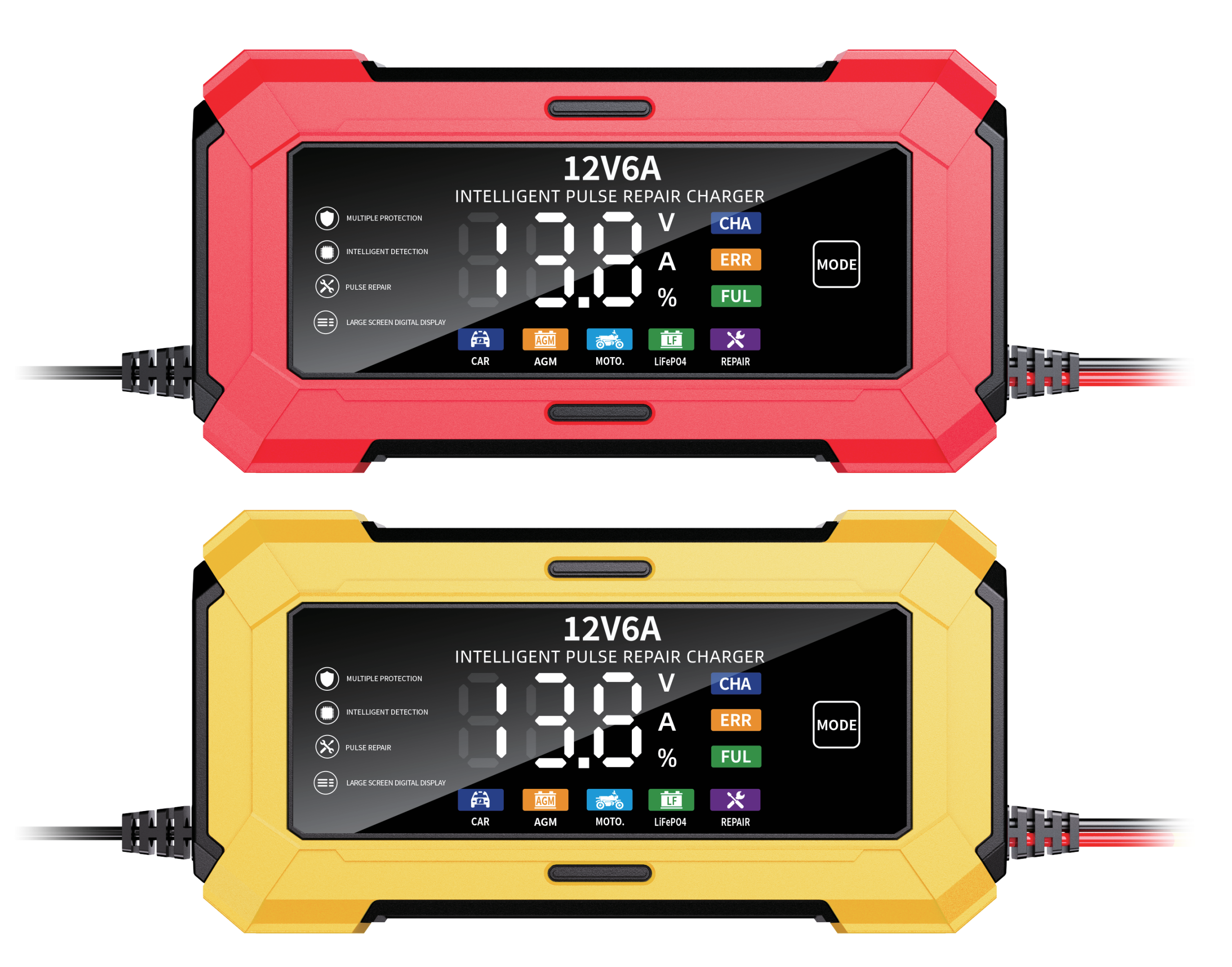
SWT-3650
12V, 6A
Compact 12V 6A model with a listed 2–100Ah battery range and a large charging-status display.
- Input
- 100–240V 50/60Hz
- Output
- 12V, 6A
- Input Power
- Max. 96W
- Listed Battery Capacity
- 2–100Ah
- Thermal Protection
- 65°C ±5°C
- Dimensions
- 145 × 77 × 53 mm
- Net Weight
- 355 g
- Automatic battery-type and voltage detection
- Multi-stage charging control
- Units per Carton
- 30 pcs
- Carton Size
- 42.6 × 42 × 30 cm
- Carton Gross Weight
- 13 kg
- Color Box Size
- 20.4 × 13.5 × 5.5 cm
- Unit Gross Weight
- 450 g
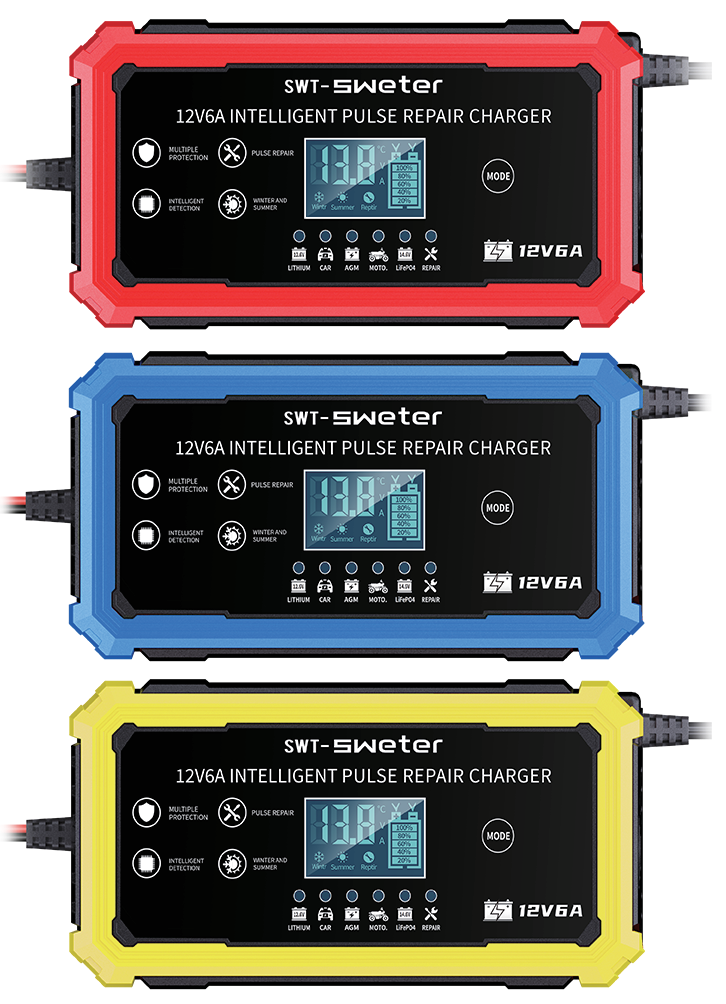
SWT-3610
12V, 6A
12V 6A, 3-stage model with a listed 2–150Ah range and a 150 × 80 × 60 mm housing.
- Input
- 100–240V 50/60Hz
- Output
- 12V, 6A
- Input Power
- Max. 96W
- Listed Battery Capacity
- 2–150Ah
- Thermal Protection
- 65°C ±5°C
- Dimensions
- 150 × 80 × 60 mm
- Net Weight
- 425 g
- 3-stage charging program
- Listed battery range: 2–150Ah
- Units per Carton
- 30 pcs
- Carton Size
- 47.6 × 37.4 × 35.7 cm
- Carton Gross Weight
- 16 kg
- Color Box Size
- 22.5 × 11.8 × 6.7 cm
- Unit Gross Weight
- 520 g
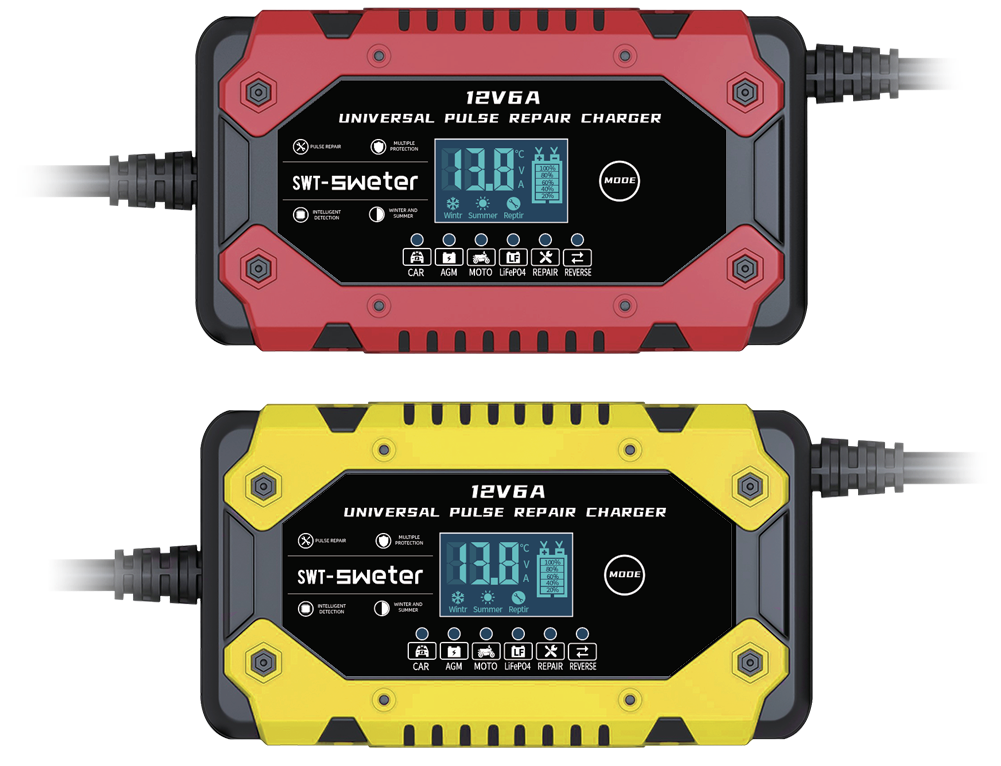
SWT-3668
12V, 6A
12V 6A, 3-stage alternative with the same listed 2–150Ah range in a 147 × 80 × 60 mm housing.
- Input
- 100–240V 50/60Hz
- Output
- 12V, 6A
- Input Power
- Max. 96W
- Listed Battery Capacity
- 2–150Ah
- Thermal Protection
- 65°C ±5°C
- Dimensions
- 147 × 80 × 60 mm
- Net Weight
- 460 g
- 3-stage charging program
- Alternative housing design
- Units per Carton
- 30 pcs
- Carton Size
- 47.6 × 37.4 × 34.7 cm
- Carton Gross Weight
- 16 kg
- Color Box Size
- 22.5 × 11.5 × 6.5 cm
- Unit Gross Weight
- 526 g
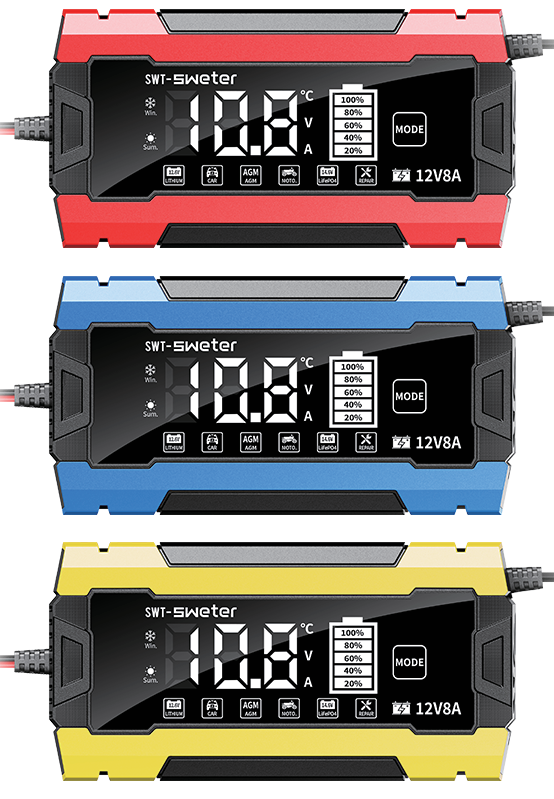
SWT-3820 — Standard Display
12V, 8A
12V 8A, 3-stage variant for batteries within the listed 2–200Ah range, equipped with a standard display.
- Input
- 100–240V 50/60Hz
- Output
- 12V, 8A
- Display
- Standard Display
- Input Power
- Max. 120W
- Listed Battery Capacity
- 2–200Ah
- Thermal Protection
- 65°C ±5°C
- Dimensions
- 163 × 83 × 60 mm
- Net Weight
- 455 g
- 3-stage charging program
- Standard display version
- Units per Carton
- 30 pcs
- Carton Size
- 47.6 × 36 × 36.5 cm
- Carton Gross Weight
- 16.8 kg
- Color Box Size
- 23 × 11.5 × 6.8 cm
- Unit Gross Weight
- 550 g
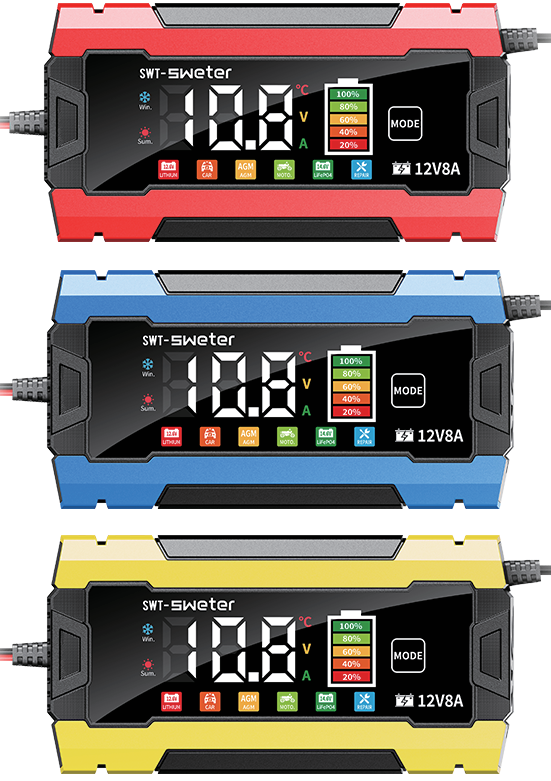
SWT-3820 — Color Display
12V, 8A
12V 8A, 3-stage variant for batteries within the listed 2–200Ah range, equipped with a color display.
- Input
- 100–240V 50/60Hz
- Output
- 12V, 8A
- Display
- Color Display
- Input Power
- Max. 120W
- Listed Battery Capacity
- 2–200Ah
- Thermal Protection
- 65°C ±5°C
- Dimensions
- 163 × 83 × 60 mm
- Net Weight
- 455 g
- 3-stage charging program
- Color display version
- Units per Carton
- 30 pcs
- Carton Size
- 47.6 × 36 × 36.5 cm
- Carton Gross Weight
- 16.8 kg
- Color Box Size
- 23 × 11.5 × 6.8 cm
- Unit Gross Weight
- 550 g
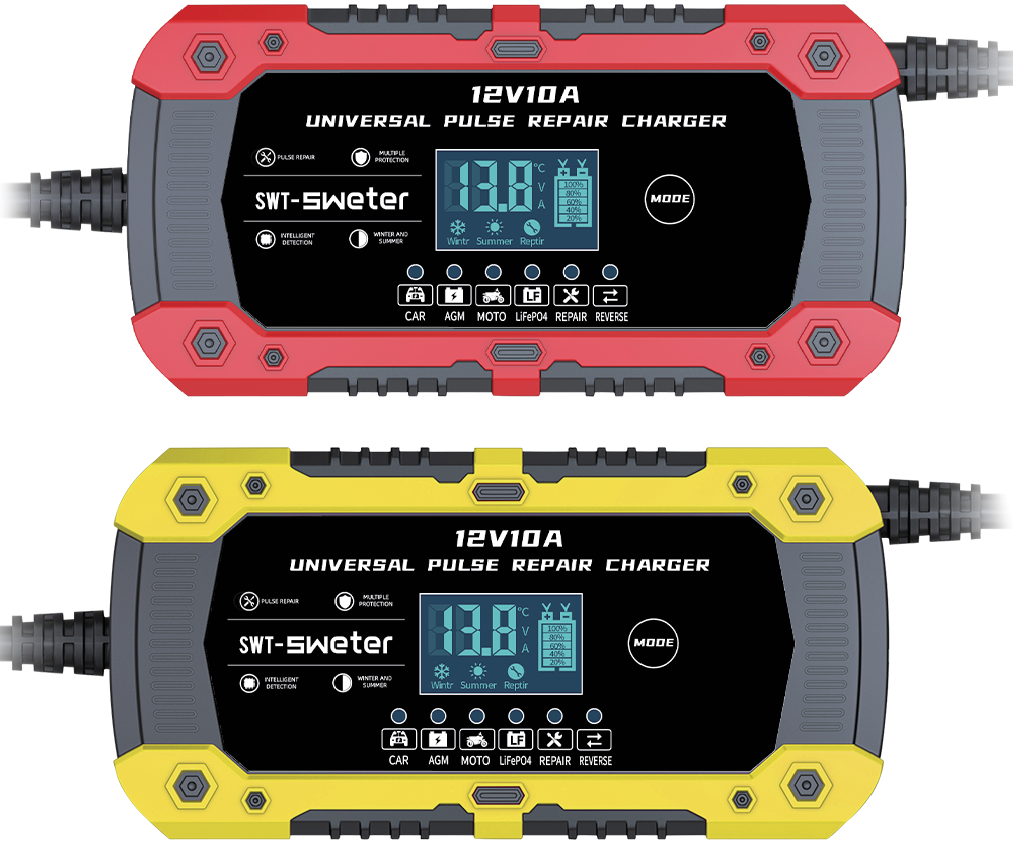
SWT-1880
12V, 10A
12V 10A, 3-stage model for batteries within the listed 2–200Ah range, using a 163 × 88 × 60 mm housing.
- Input
- 100–240V 50/60Hz
- Output
- 12V, 10A
- Input Power
- Max. 150W
- Listed Battery Capacity
- 2–200Ah
- Thermal Protection
- 65°C ±5°C
- Dimensions
- 163 × 88 × 60 mm
- Net Weight
- 515 g
- 3-stage charging program
- 12V 10A output
- Units per Carton
- 30 pcs
- Carton Size
- 47.6 × 40 × 35.7 cm
- Carton Gross Weight
- 19 kg
- Color Box Size
- 23 × 13 × 6.5 cm
- Unit Gross Weight
- 609 g
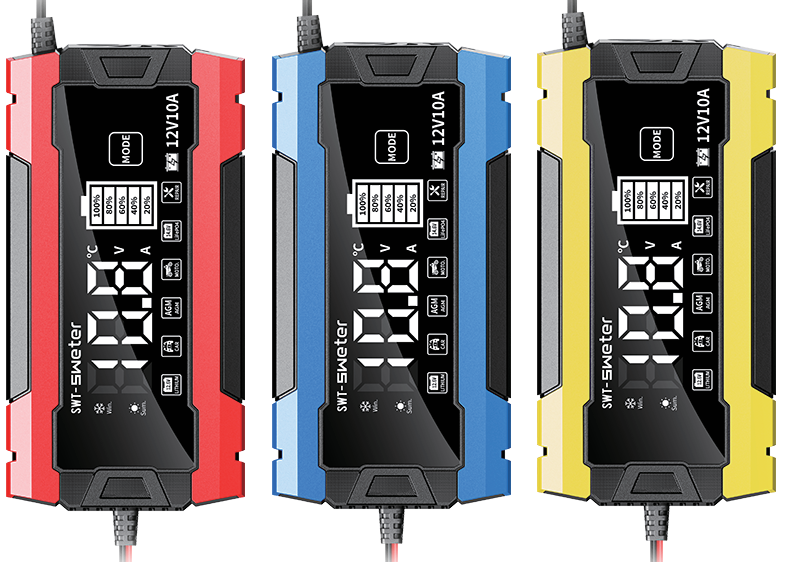
SWT-3830 — Standard Display
12V, 10A
12V 10A, 3-stage model for batteries within the listed 2–200Ah range, equipped with a standard display.
- Input
- 100–240V 50/60Hz
- Output
- 12V, 10A
- Display
- Standard Display
- Input Power
- Max. 150W
- Listed Battery Capacity
- 2–200Ah
- Thermal Protection
- 65°C ±5°C
- Dimensions
- 163 × 83 × 60 mm
- Net Weight
- 515 g
- 3-stage charging program
- Standard display version
- Units per Carton
- 30 pcs
- Carton Size
- 47.6 × 36 × 36.5 cm
- Carton Gross Weight
- 18 kg
- Color Box Size
- 23 × 11.5 × 6.8 cm
- Unit Gross Weight
- 610 g
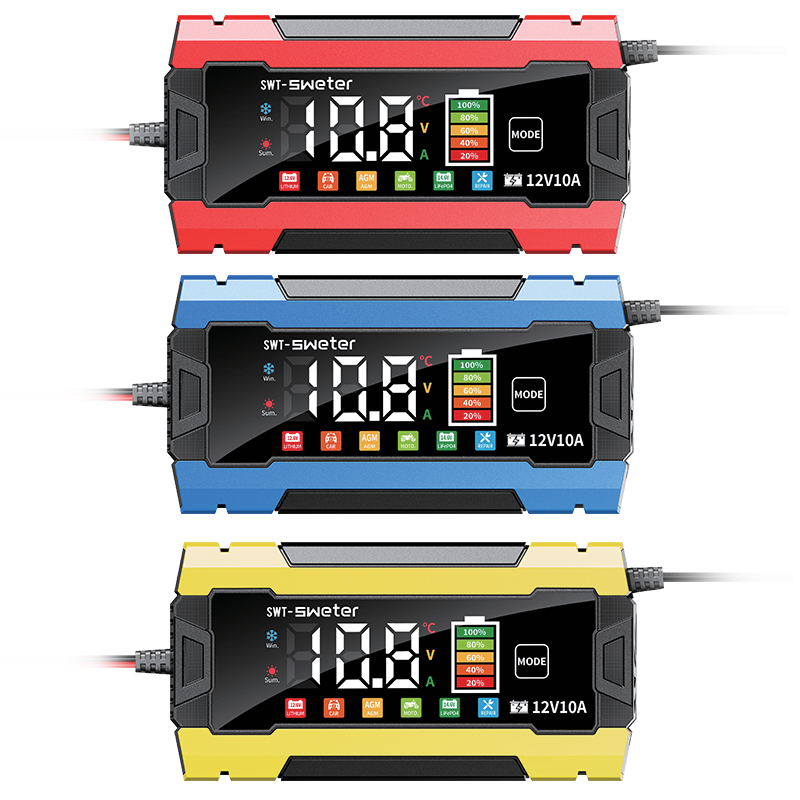
SWT-3830 — Color Display
12V, 10A
12V 10A, 3-stage model for batteries within the listed 2–200Ah range, equipped with a color display.
- Input
- 100–240V 50/60Hz
- Output
- 12V, 10A
- Display
- Color Display
- Input Power
- Max. 150W
- Listed Battery Capacity
- 2–200Ah
- Thermal Protection
- 65°C ±5°C
- Dimensions
- 163 × 83 × 60 mm
- Net Weight
- 515 g
- 3-stage charging program
- Color display version
- Units per Carton
- 30 pcs
- Carton Size
- 47.6 × 36 × 36.5 cm
- Carton Gross Weight
- 18 kg
- Color Box Size
- 23 × 11.5 × 6.8 cm
- Unit Gross Weight
- 610 g
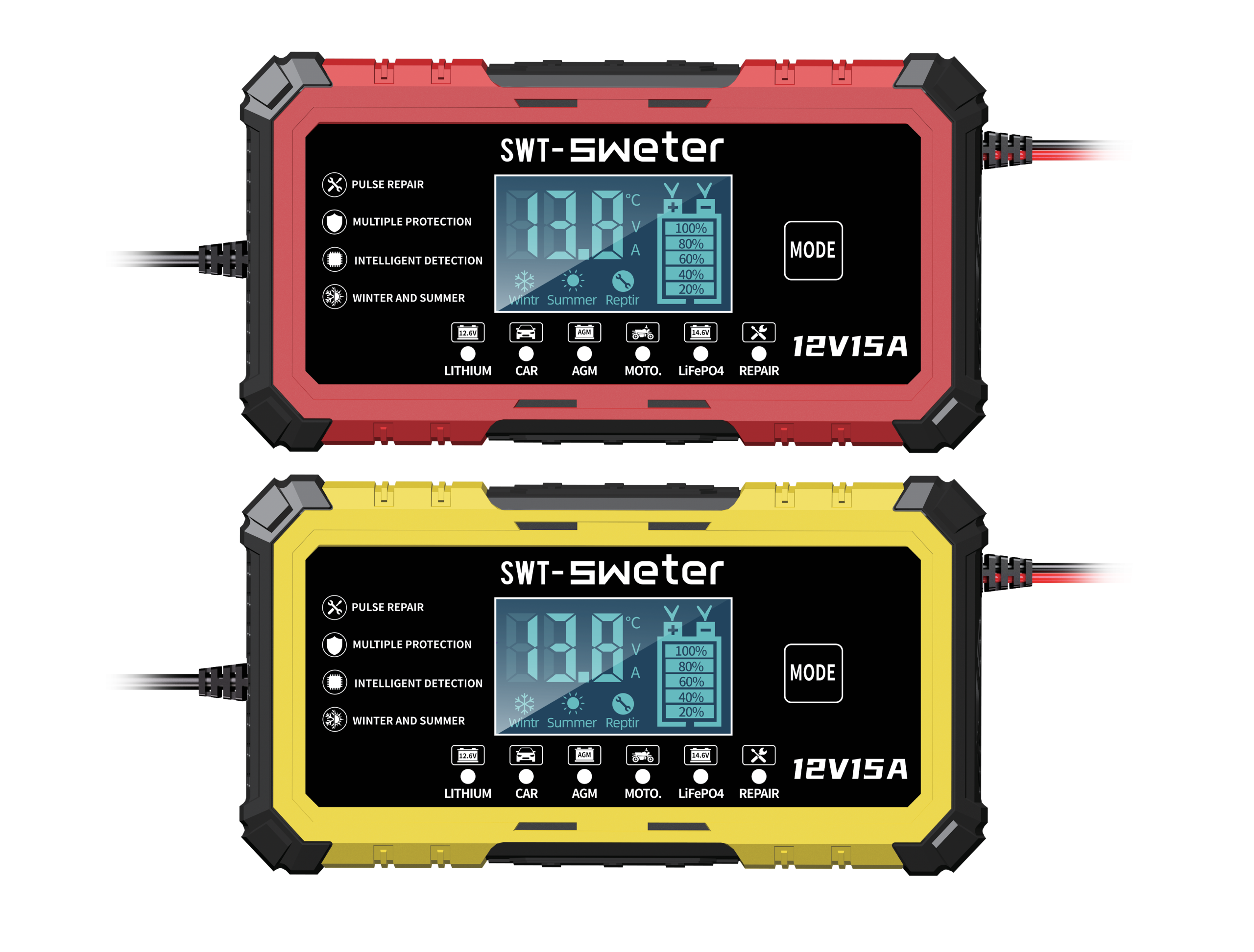
SWT-1215
12V, 15A
The highest-current 12V-only variant on this page, with 15A output and a listed 4–300Ah battery range.
- Input
- 100–240V 50/60Hz
- Output
- 12V, 15A
- Input Power
- Max. 230W
- Listed Battery Capacity
- 4–300Ah
- Thermal Protection
- 65°C ±5°C
- Dimensions
- 192 × 100 × 73 mm
- Net Weight
- 850 g
- 3-stage charging program
- Listed battery range: 4–300Ah
Carton details available on request
12V / 24V Smart Battery Charger Models
Six dual-voltage variants cover 12V 10A / 24V 5A through 12V 25A / 24V 15A, with 200-second booster mode on SWT-1608, SWT-2010 and SWT-2025.
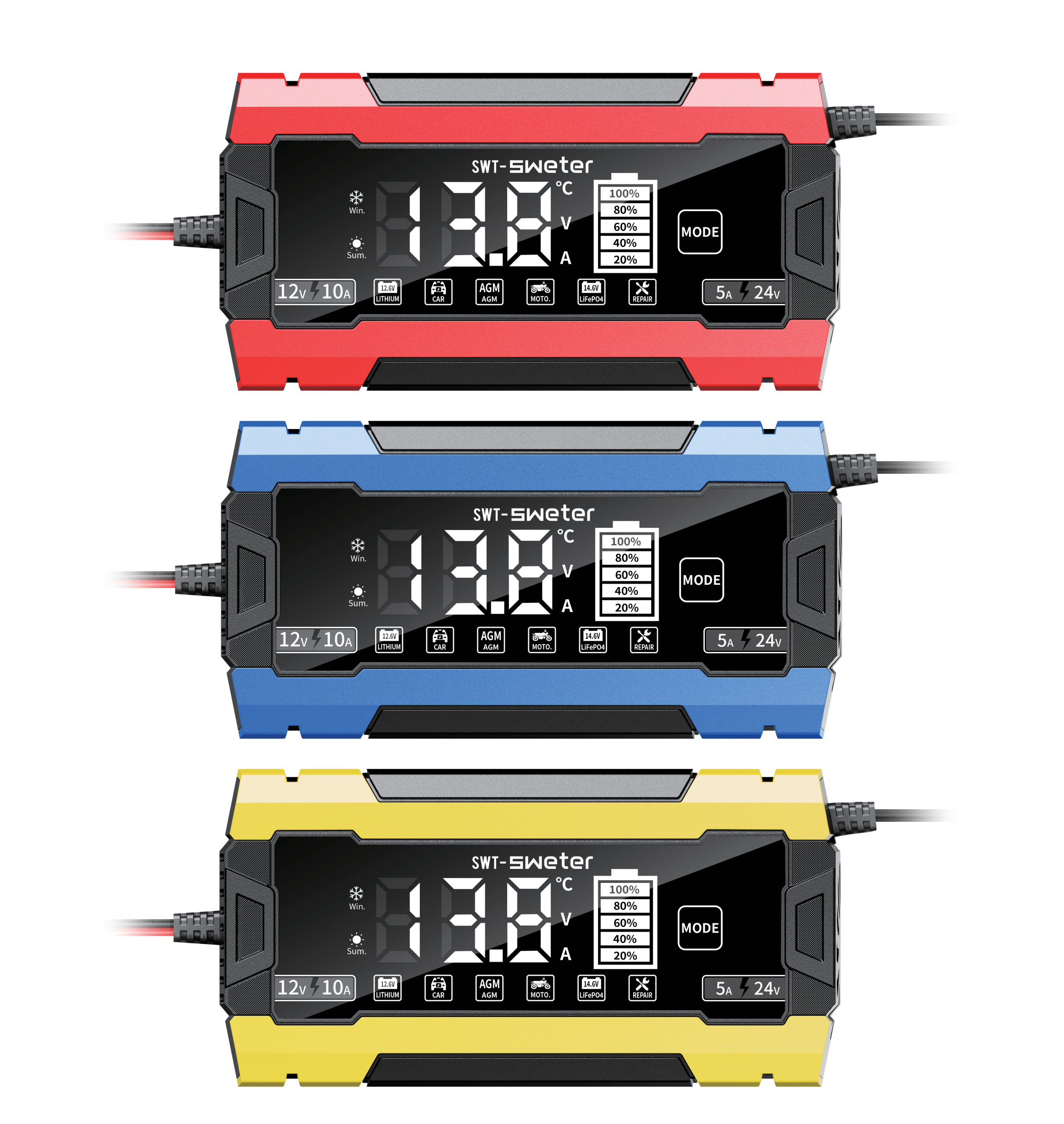
SWT-1205
12V 10A / 24V 5A
Entry dual-voltage 10-stage variant with 12V 10A or 24V 5A output and a listed 4–200Ah battery range.
- Input
- 100–240V 50/60Hz
- Output
- 12V 10A / 24V 5A
- Input Power
- Max. 150W
- Listed Battery Capacity
- 4–200Ah
- Thermal Protection
- 65°C ±5°C
- Dimensions
- 163 × 83 × 60 mm
- Net Weight
- 565 g
- 10-stage charging program
- 12V / 24V dual-voltage output
- Units per Carton
- 30 pcs
- Carton Size
- 47.6 × 36 × 36.5 cm
- Carton Gross Weight
- 21 kg
- Color Box Size
- 23 × 11.5 × 6.8 cm
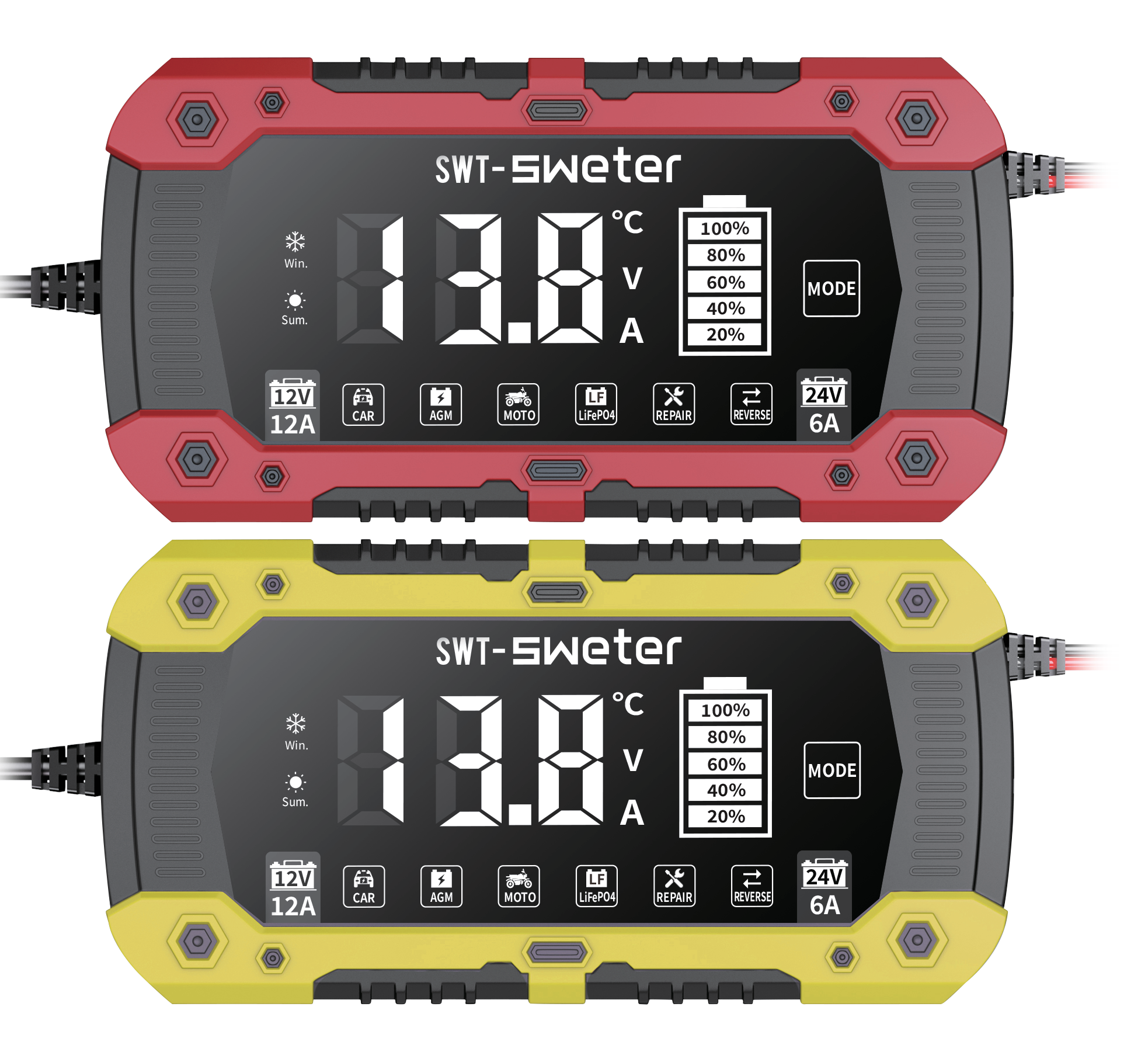
SWT-1206
12V 12A / 24V 6A
Higher-current dual-voltage 10-stage variant with 12V 12A or 24V 6A output and a listed 4–200Ah battery range.
- Input
- 100–240V 50/60Hz
- Output
- 12V 12A / 24V 6A
- Input Power
- Max. 180W
- Listed Battery Capacity
- 4–200Ah
- Thermal Protection
- 65°C ±5°C
- Dimensions
- 162 × 89 × 62 mm
- Net Weight
- 565 g
- 10-stage charging program
- 12V 12A / 24V 6A output
- Units per Carton
- 30 pcs
- Carton Size
- 47.6 × 40 × 35.7 cm
- Carton Gross Weight
- 21 kg
- Color Box Size
- 23 × 13 × 6.5 cm
- Unit Gross Weight
- 660 g
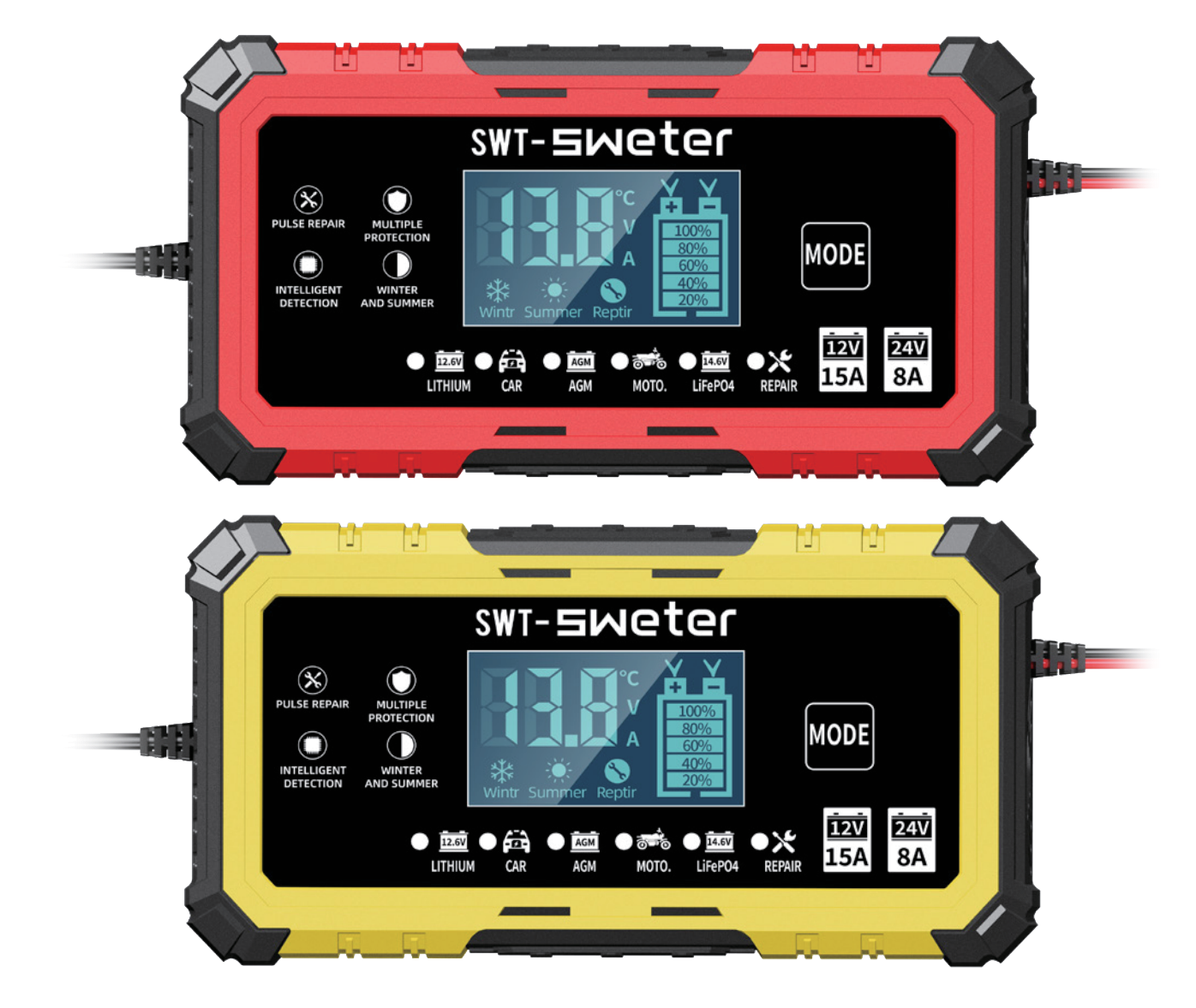
SWT-1508
12V 15A / 24V 8A
Dual-voltage 3-stage variant with 12V 15A or 24V 8A output and a listed 4–300Ah battery range.
- Input
- 100–240V 50/60Hz
- Output
- 12V 15A / 24V 8A
- Input Power
- Max. 240W
- Listed Battery Capacity
- 4–300Ah
- Thermal Protection
- 65°C ±5°C
- Dimensions
- 192 × 100 × 73 mm
- Net Weight
- 820 g
- 3-stage charging program
- Listed battery range: 4–300Ah
Carton details available on request
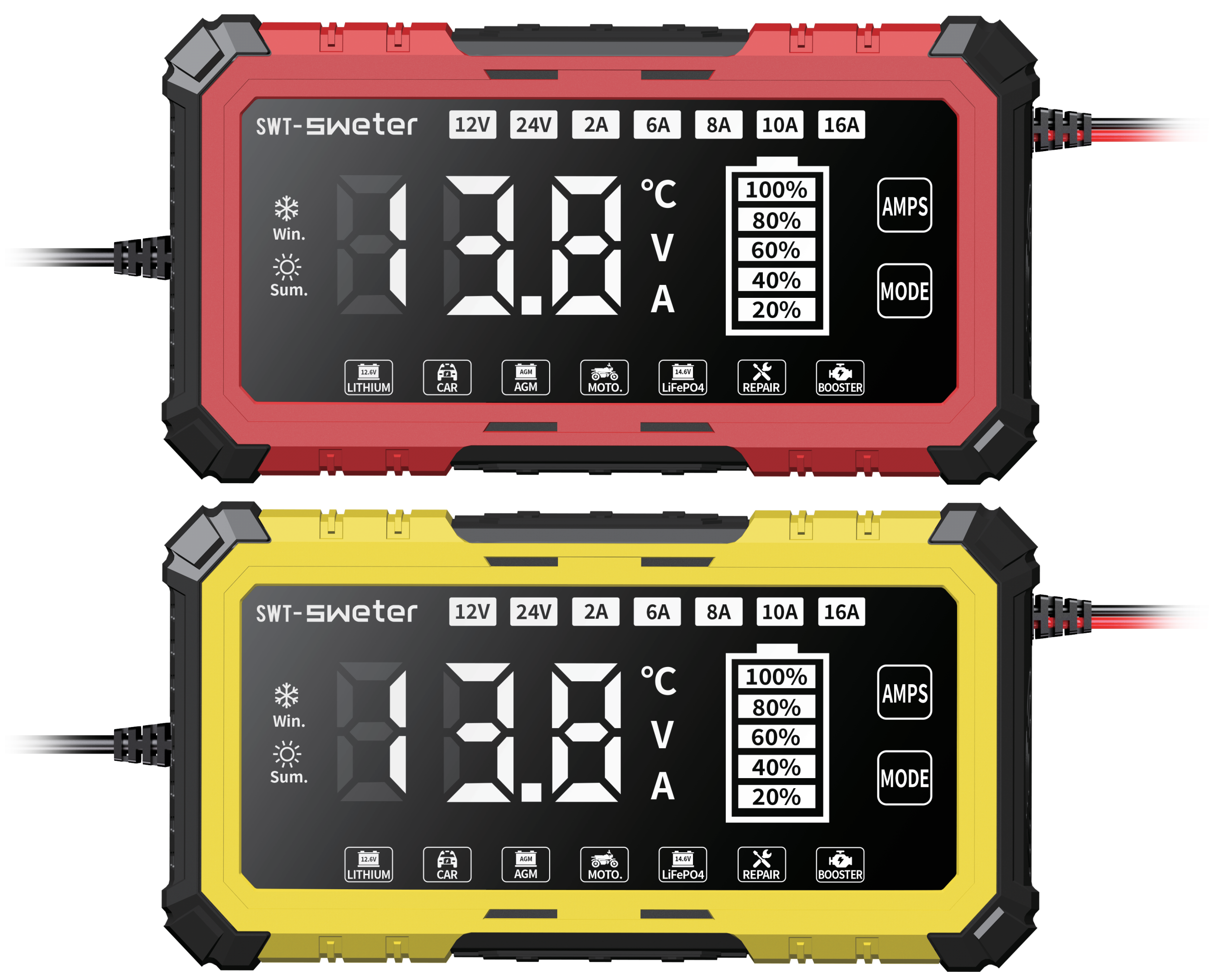
SWT-1608
12V 16A / 24V 8A
Dual-voltage 10-stage variant with 12V 16A or 24V 8A output and a listed 200-second booster mode for assisting a 12V vehicle start.
- Input
- 100–240V 50/60Hz
- Output
- 12V 16A / 24V 8A
- Input Power
- Max. 240W
- Listed Battery Capacity
- 4–300Ah
- Thermal Protection
- 65°C ±5°C
- Dimensions
- 192 × 100 × 73 mm
- Net Weight
- 775 g
- 10-stage charging program
- 200-second 12V booster mode
- Units per Carton
- 24 pcs
- Carton Size
- 52 × 44 × 31.6 cm
- Carton Gross Weight
- 22 kg
- Color Box Size
- 25 × 14.2 × 7.5 cm
- Unit Gross Weight
- 900 g
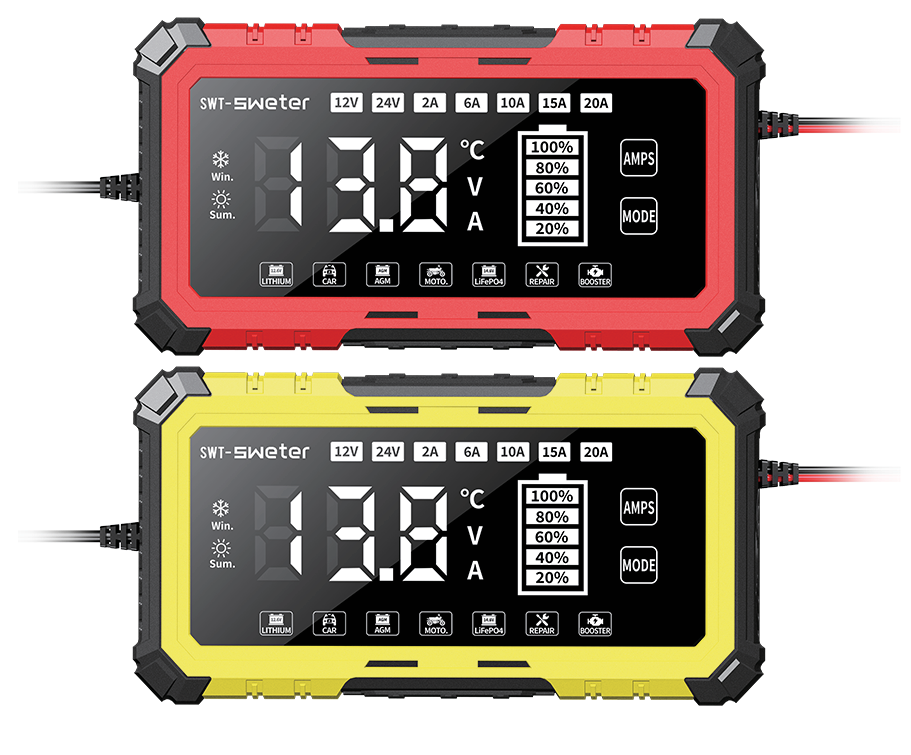
SWT-2010
12V 20A / 24V 10A
Dual-voltage model with 12V 20A or 24V 10A output, a listed 4–400Ah range and a 200-second 12V booster mode.
- Input
- 100–240V 50/60Hz
- Output
- 12V 20A / 24V 10A
- Input Power
- Max. 300W
- Listed Battery Capacity
- 4–400Ah
- Thermal Protection
- 65°C ±5°C
- Dimensions
- 192 × 100 × 73 mm
- Net Weight
- 820 g
- 10-stage charging program
- 12V 20A / 24V 10A output; listed 4–400Ah battery range
Carton details available on request
SWT-2025
12V 25A / 24V 15A
The highest-current model in this range combines 12V 25A / 24V 15A charging with a carry handle, a 10-stage charging program and a 200-second booster mode for assisting a 12V vehicle start. Listed battery capacity: 4–400Ah.
- Input
- 100–240V 50/60Hz
- Output
- 12V 25A / 24V 15A
- Input Power
- Max. 350W
- Listed Battery Capacity
- 4–400Ah
- Thermal Protection
- 65°C ±5°C
- Dimensions
- 210 × 150 × 105 mm
- Net Weight
- 1.15 kg (1150 g)
- Charging Program
- 10-stage
- Booster Mode
- 200-second / 12V
Battery Compatibility
- Lead-acid batteries, including AGM and GEL
- LiFePO4: 14.6V / 29.2V charging modes
Select the mode that matches the battery chemistry and specified charging voltage. Pulse repair is for compatible lead-acid batteries.
- Carry handle for convenient transport
- Temperature compensation and charging-status display
- Reverse-polarity, short-circuit and overcharge protection
- Units per Carton
- 8 pcs
- Carton Size
- 50 × 38.2 × 24.5 cm
- Carton Gross Weight
- 12.5 kg
- Unit Packaging Size
- 24 × 18 × 11.5 cm
- Unit Gross Weight
- 1.44 kg (1440 g)
Smart Charging & Protection Features
Available functions vary by model. Review the selected product specifications and operating instructions before use.
Automatic Staged Charging
The range includes multi-stage, 3-stage and 10-stage charging programs depending on the selected model.
Temperature Compensation
Listed models adjust charging behavior according to ambient-temperature conditions to reduce undercharging or overcharging risk.
Charge-Completion Control
Smart control reduces or stops charging when the programmed full-charge condition is reached.
Electrical Protection
Reverse-polarity, short-circuit and overcharge protection are listed across the range. Additional over-voltage, over-current, over-temperature and spark-free functions vary by model.
Charging-Status Display
The listed variants provide charging and battery-status information through LCD, standard-display or color-display interfaces.
Pulse Recovery
Pulse-repair functions are intended only for compatible lead-acid batteries under suitable discharge or sulfation conditions.
Features vary by model. Do not assume that every function is included in every variant.
How to Choose the Right Smart Battery Charger
1. Match the Battery Voltage
Use SWT-3612 for a compatible 6V or 12V battery. Use a 12V-only model for 12V batteries. Choose SWT-1205, SWT-1206, SWT-1508, SWT-1608, SWT-2010 or SWT-2025 when both 12V and 24V charging are required.
2. Confirm the Battery Chemistry
Select the correct charging mode for AGM, GEL, flooded or WET lead-acid, standard lead-acid or LiFePO4 batteries as permitted by both the charger and battery manufacturer.
3. Check the Listed Ah Range
Choose a charger whose listed battery-capacity range includes the battery you intend to charge.
4. Confirm the Allowed Charging Current
Do not choose current by charging speed alone. The charger output must not exceed the battery manufacturer’s maximum recommended charging current.
Approximate charging time depends on the amount of capacity that must be replaced. Dividing the required amp-hours by charger current gives only a rough constant-current estimate. Actual total time is longer because charging current tapers and electrical losses occur.
Battery Charger vs. Battery Maintainer vs. Jump Starter
| Product Type | Main Purpose | What It Does Not Do |
|---|---|---|
| Battery Charger | Restores battery energy over time through a controlled charging program | It does not provide the same instant cranking current as a jump starter |
| Battery Maintainer | Keeps an already charged battery near its target level during storage | It is not intended to rapidly recharge a deeply discharged battery unless the device also includes a charging function |
| Jump Starter | Provides a short high-current burst to help crank an engine | It does not fully recharge or maintain the vehicle battery |
A jump starter may get a vehicle running after an accidental discharge, but it does not restore the battery’s full state of charge. A smart charger is used to recharge the battery and may also provide maintenance functions. A physically damaged or irreversibly aged battery should be tested and replaced rather than repeatedly repaired.
What Can Pulse Repair Mode Actually Do?
Pulse repair mode is intended for compatible lead-acid batteries affected by certain discharge or sulfation conditions. It may improve charging acceptance in some cases, but the result depends on battery condition.
Pulse repair cannot repair a cracked battery case, electrolyte loss, an internal short circuit, physically damaged plates or irreversible battery aging. It also cannot guarantee that a battery will recover its original capacity.
Do not use a lead-acid pulse-repair program on a lithium battery unless the selected charger mode and battery manufacturer explicitly permit it.
B2B CUSTOMIZATION
OEM & Private-Label Smart Battery Chargers
CNLI supports charger customization for distributors, wholesalers and private-label brands. Confirm the required electrical specification and market configuration before production.
Brand Logo & Product Label
Apply confirmed customer branding and product-label information.
Retail Packaging
Develop project-specific packaging boxes and printed information.
AC Input Plug
Configure EU, US, UK, AU or other confirmed input-plug requirements.
DC Output Connection
Configure crocodile clips, XLR, XT60, Anderson or another confirmed connector.
Cable Length & Wiring
Confirm cable length, connector polarity and project-specific wiring requirements.
Custom Electrical Projects
Discuss required output voltage and current for charger projects outside the standard models shown on this page.
PROJECT PROCESS
Information Needed for a Charger Project
Send Battery Requirements
Provide battery voltage, chemistry, capacity in Ah, permitted charging current, application and connector requirements.
Confirm Model or Customization
Confirm the standard model or required branding, packaging, input plug, output connector and cable configuration.
Confirm Order Details
Confirm the target market, estimated quantity, documentation requirements, sample requirements and packaging details before production.
COMPLIANCE
Confirm Certification by Model and Market
Certification and document availability vary by charger model and destination market. Ask CNLI to confirm the exact model number, applicable standard and available report or declaration before placing an order.
Do not assume that a certificate or test report issued for one charger automatically covers another model, output specification or market.
Technical References
For general technical and regulatory context, refer to the primary sources below. Final compliance and document availability must still be confirmed for the specific charger model, configuration and destination market.
IEC safety requirements covering certain battery chargers for household and similar applications.
Official guidance on manufacturer responsibilities, conformity assessment, technical documentation and the EU Declaration of Conformity.
Official EU legislation concerning electromagnetic compatibility requirements for equipment within its scope.
FAQ
12V & 24V Smart Battery Charger FAQ
How do I choose the correct battery charger?
Confirm the battery voltage, chemistry, capacity in Ah and the battery manufacturer's maximum recommended charging current. Then use the comparison table to select a model whose output and listed battery-capacity range match those requirements.
Which model on this page supports 6V batteries?
SWT-3612 is the only listed 6V-capable variant on this page. It provides 6V 1.5A or 12V 1.5A output and has a listed battery range of 2–30Ah.
Which models can charge both 12V and 24V batteries?
The dual-voltage models are SWT-1205, SWT-1206, SWT-1508, SWT-1608, SWT-2010 and SWT-2025. Their 24V output ranges from 5A to 15A.
Can these chargers charge AGM, GEL and flooded lead-acid batteries?
Compatibility with AGM, GEL and flooded or WET lead-acid batteries is listed across the product range. Select the correct charging mode and confirm the requirements of the specific battery before use.
Can these chargers charge LiFePO4 batteries?
LiFePO4 compatibility is listed for the models on this page. Use only the charger's lithium-compatible mode and confirm the charging voltage, current and BMS requirements of the battery. Do not use a lead-acid pulse-repair mode on a lithium battery.
What does pulse repair mode do?
Pulse repair is intended for compatible lead-acid batteries affected by certain discharge or sulfation conditions. It may improve charging acceptance in some cases, but it cannot repair physical damage, internal short circuits or irreversible aging.
Can a smart charger recover a completely dead battery?
Not always. A battery below the charger's detection threshold, affected by an internal fault or damaged by irreversible aging may not accept charging. Battery condition should be tested when recovery does not begin normally.
Can I leave the charger connected after the battery is full?
The listed smart chargers include automatic full-charge control, but continuous-connection behavior depends on the exact model and selected charging mode. Follow the operating instructions supplied with the specific charger.
How long will it take to charge a battery?
Charging time depends on the amount of capacity that must be replaced, charger current, battery condition and the charging stage. Dividing the required amp-hours by charging current provides only a rough estimate; total charging time will normally be longer.
What is the difference between a battery charger and a jump starter?
A battery charger restores battery energy over time. A jump starter supplies a brief high-current burst to crank an engine but does not fully recharge the vehicle battery.
Which models include engine-start assistance?
SWT-1608, SWT-2010 and SWT-2025 include a listed 200-second booster mode intended to assist starting a 12V vehicle.
Can the charger plug, connector and packaging be customized?
Yes. Available project options include branding, packaging, AC input plugs, DC output connectors, cable length and connector wiring. Final availability must be confirmed for the selected model and order.
What information should I send for a model recommendation?
Send the battery voltage, chemistry, capacity in Ah, permitted charging current, required connector, application, target country and estimated order quantity.
Are the certifications the same for every charger model?
No. Certification and document availability can vary by model, electrical specification and destination market. Confirm the exact model and required standard before ordering.
Which lithium charging modes does SWT-2025 support?
SWT-2025 lists LiFePO4 charging modes at 14.6V / 29.2V. Match the selected mode to the battery chemistry, charging voltage, permitted current and BMS requirements. These mode specifications apply to SWT-2025; confirm other models separately.
What are the SWT-2025 packaging specifications?
SWT-2025 is packed 8 units per carton. Carton size is 50 × 38.2 × 24.5 cm with a gross weight of 12.5 kg. Each unit weighs 1.15 kg net and 1.44 kg packed; unit packaging measures 24 × 18 × 11.5 cm.
MODEL SUPPORT
Not Sure Which Charger Fits Your Battery?
Send us your battery voltage, chemistry, capacity in Ah, permitted charging current, required connector, target market and estimated order quantity. We will use this information to narrow the suitable standard or customized charger options.
- Battery voltage
- Battery chemistry
- Battery capacity in Ah
- Maximum permitted charging current
- Application
- Required AC plug
- Required DC connector
- Target country or market
- Estimated order quantity
- OEM or private-label requirements